Musings, philosophy, arguments on vegetarian living, from the heart of Europe (Belgium, that is).

Sunday, February 9, 2014

On meat eating and rationality: Richard Dawkins and Sam Harris

my new blog is at http://vegansapiosexual.wordpress.com

A late professor of mine once said: “if you want to quickly anger even the most reasonable person and make sure that he or she is no longer thinking rationally, start a conversation about eating meat.” 

I have found that this - the part about not thinking rationally about meat eating - applies even to the most rationally thinking people. Even the people that have made it their mission to root out all kinds of irrationality and superstition, seem to have a big blind spot when it comes to reasoning about eating animals. 

Yes, i’m talking about - and selecting by way of example - people like Richard Dawkins or Sam Harris. In case you’re not familiar with their work, referring to the respective foundations that each of them started should be enough to convince you of the role rationality and reason play in their lives. Richard Dawkins founded the Foundation for Reason and Science, while Sam Harris is co-founder of Project Reason, a foundation devoted to spreading scientific knowledge and secular values in society. Together with philosopher Daniel Dennett and the late journalist and writer Christopher Hitchens, Dawkins and Harris are among the most important “new atheists” and are called the four (now three) “Horsemen of New Atheism”. These scholars are on a mission to root out all forms of irrational thinking.

Let’s take a look at what Dawkins and Harris have to say about eating animals. First a side note: it is not my intention here to detract to their work in any way. I greatly admire their writing and debating and believe, as they do, in the importance of reason and rational inquiry in our daily lives, including education. I do feel free, however, to criticize their reasoning and behaviour, as they themselves are (in many or most cases rightly I think) never shy of doing that with other people.

In a youtube video called Harris answers the question whether he can ethically defend eating meat. Harris’s answer is that he actually can’t. This is very much to his credit, but he goes on doing exactly that: defending eating meat. He was a vegetarian for six years, but “began to feel that he wasn’t eating enough protein”. So he got back to eating meat and felt much better. He thinks that “it’s hard to be an active and intelligent and fit vegetarian - at least it was hard for me”. He continues to say that he can’t defend the way we treat animals and “the nature of what life is like in an abbatoir”. He adds that he also can’t defend delegating that. He will defend any attempt to make things better and more compassionate, and “the moment that we had a real substitute for [meat], the moment we had synthetic meat, I think we would have an ethical obligation to do that”. It’s unethical to delegate something that you wouldn’t do yourself. If you’d be horrified to kill an animal... to have it done out of sight and out of mind is not an ethical solution.” 
Obviously, Sam Harris is thinking more “straight” and intelligently about this issue than 95% of the population, yet still, the issue I have is that a person putting such a premium on rational thought (and action) might have a more consistent view and behaviour in these matters, and could be better informed. For instance, we really can safely say that a vegetarian or vegan diet can be nutritionally adequate, and that today, certainly in New York (where Harris lives), and certainly for a well off person (which Harris is), it is not hard at all to maintain it and be healthy. The argument that we have the ethical obligation as soon as an exact copy of meat is developed (synthetic meat) is in my opinion false: nutritionally it is not hard to replace meat, so we don’t need that substitute, or at least, we have enough of them already. In case he would also be talking in terms of taste (which a lot people are attaching more importance to than to health in these matters), the statement would boil down to this: we can continue to torture and kill animals by the millions as long as we haven’t developed something that’s just as tasty. This is obviously unethical. Moreover, more and more alternatives appear on the market that are virtually indistinguishable from meat.

Professor Richard Dawkins then. He was asked the following question by Peter Singer: 
“The darwinian view undermines the basis for some of the distinctions we draw between us and animals. If we get rid of preconceptions like... people are made in the image of god, or that god gave us dominion over the animals, we would take a different view of the moral status of animals, that would require us to treat them in very different ways from the idea that they are just things for us to use as we see fit.” Singer asks if as a darwinian Dawkins shares that view.

Dawkins replies that it is a logical consequence of the darwinian view that there is continuity between the species. I’m quoting/transcribing the rest of his answer in full here:

“It implies that all of us who are eating meat, including me, are in a very difficult moral position. What I am doing is going along with the fact that I live in a society where meat eating is accepted as the norm and it requires a level of… social courage, which I haven’t yet produced, to break out of that. It’s a little bit like the position which anybody, not everybody but many people, would have been in a couple of hundreds of years ago over slavery, where lots of people felt kind of morally uneasy about slavery but went along with it, because... the whole economy of the south depended upon slavery. Of course none of us like the idea of slavery but ‘you can’t seriously consider doing away with it because the whole economy would collapse’... I find myself in something like that situation. I think what I’d really like to see would be a mass consciousness raising movement so that we all become vegetarian and then it would be so much easier for those of us who find it difficult to go along with it. And quite apart from that you’d then have brilliant chefs making wonderful recipes.”

Again, much like Sam Harris’s treating of this topic, Dawkins’s reply is much more conscious and intelligent than how 95% of the population would reply. Dawkins admits that not being a vegetarian is a difficult position for a darwinian, yet much like Harris goes on to defend (or at least explain) his position as a non-vegetarian, with rather weak arguments. Think, for a moment, about his comparison with slavery. Should we not be able to expect from people at the forefront of rational thought, ethics and fairness (which Dawkins undoubtedly is)  that they are among the first to adopt practises that they see as fair and abandoning practises that they see as unethical, instead of being, so to speak, laggards? Indeed we might expect from Dawkins that he is part of the mass consciousness raising movement that he is waiting for (and which is actually going on presently). And a person who has the social courage to talk and write very controversially about religion, islam, pedophilia... wouldn't find in himself that same social courage to quit steak and porkchops?

Perhaps all of this might sound unfair to Dawkins and Harris , as one cannot be an early adopter in everything, but this goes so directly to the core of their work and life that I cannot interpret it as anything else than a very meagre defense. Here are people who expect people to consider the irrationality of religion and consequently give it up, while they themselves are unable, for social reasons, to give up a practice as abhorrent as meat eating, even though they are rationally convinced they should. At the very least they might go for a “mostly vegetarian or vegan” diet, and make exceptions when they feel these are acceptable. 

I would try to explain these inconsistencies by means of the framework created by the psychologist Melanie Joy called carnism. Joy calls eating meat an ideology, up to now mostly invisible. Three major components of that ideology are what she calls the three Ns of justification: meat is natural, normal and necessary. Most of us are so deep into this invisible ideology that we have absolutely no idea to which extent these false ideas are influencing our reasoning and our behaviour in this area. 

 People do not change their behaviour by reason alone. Dawkins referred to the importance of having good chefs creating great dishes. What our environment has to offer in terms of alternatives is certainly a paramount factor in behaviour change, in any field. Yet thinking is obviously important as well. I venture to say that we may expect of great, rational minds that they start thinking things through about meat, and start wondering whether meat is indeed natural, normal or necessary. And perhaps it might even be expected of them to act upon their conclusions. 

Friday, January 3, 2014

Beyoncé and compassion

An article on how Beyoncé and Jay-Z have "abandon" their vegan diet cleanse caught my attention. I think the article greatly reflects a lot of things that are far from optimal in our vegan movement. Let me explain.

First of all, the author of the article assumes a lot of things. She assumes that she knows why Beyoncé and Jay-Z started the vegan cleanse, she assumes she knows why they are now ending it, why they visited a non vegan restaurant, etc. She assumes it's for all the wrong reasons. I think there may indeed be indications that the famous couple might be interested in some self promotion, likes to draw attention, and whatever, but these indications are not sufficient reason to assume we know everything there is to know.

Secondly - and more importantly - the author judges Beyoncé and Jay-Z for not eating vegan for the right reasons (ethical ones) and not going beyond diet. It is something that has haunted the movement for the last few decades: if you go vegan, it has to be for the animals. Hence, also, veganism is more than diet: you avoid hurting animals not just in your diet, but also in your whole lifestyle, which should be based on compassion and nothing else (certainly not on fads, health concerns, or whatever).

Now, as a vegan myself, who turned and is still vegan mainly for the animals, I can understand the author's concern. We love people to empathize with the animals' suffering, we want them to be compassionate, we want them to forego animal products for the right reasons. But can we stop and think for a minute about how we want to achieve that?

People may start out on the road to veganism and compassion for other reasons than veganism or compassion. They may start eating vegan because of peer pressure, because of health concerns, because of no matter what. But the important thing is, once they are on that road, once they realize that eating vegan is tastier, easier, more doable than they thought it was, their defenses against the vegan philosophy start to crumble. Their hearts and minds open up to our ethical arguments, and they may, finally, become "one of us".

Now our part in this process is to encourage every step, no matter how small, no matter the reason. It is our encouragement and not our judgement that will help them go further.

Not a single one of us arrives at the end point with one single step. Vegans too, still have a lot to learn. Patience, understanding and... compassion, both for others and for ourselves, will get us where we want the world to be.

PS: I guess I judged some people as being judgemental and thus made the same mistake. Perhaps that helps prove my point :-)

Thursday, April 11, 2013

This is your life

Yesterday, on the plane to New York, I saw the movie Arbitrage. Richard Gere plays a wealthy financial consultant who seems to lead the perfect life, but deceives friends and family as he digs his own grave. In a conversation with their daughter Brooke, who has found out the truth about her father's schemes, Gere's wife says to her that Brooke needs to do what's right not for her father or for her mother, but for herself. "This is your life," she tells her daughter.

It struck me that those four words, "this is your life", can be some of the most respectful words one can utter to another living being. And I was thinking that they can also apply to our relationship with animals. To them too we can say: "This is your life". This is your life, feel free to live it, I'm not going to kill and eat you.

We're under no moral obligation to say it, we're still allowed to have many animals killed and eat them. But as far as we know we're the only species in the universe that has evolved to the point where we have moral apparatus to be able to say: "This is your life." Isn't that something?

Thursday, October 4, 2012

Making compassion easier

October 4 is the birthday of Saint Francis of Assisi, the Italian saint who according to legend could talk with animals. On that day, we celebrate World Animals Day. The situation of the animals in this world is kind of similar to the situation of the humans: some of them bathe in luxury - mostly the companion animals or “pets” in the rich countries - while many more live a life that’s nasty, brutish and short: the animals we eat.

Pigs are at least as intelligent and capable of experiencing emotions as dogs, but as we want to buy their meat at as cheap a price as possible, the pigs of this world mostly lead short lives of fear, stress, pain and boredom. As a society, we do things with pigs, chickens and cows that we would never do to our companion animals. If you ask people’s opinions about eating animals, many or most of them will answer that we are allowed to do it, but that we must make sure they at least have “a good life”. Yet these very same people buy just any meat from the supermarket and when they eat out. That’s meat from intensive animal agriculture.


You could call these consumers inconsistent or even hypocritical, but I’d like to call on a more human-friendly explanation: for most people, compassion towards the animals we eat is not easy.

We are empathic beings - at least that’s my assumption. When another human being suffers, we feel it. We can also empathize with animals, sometimes even more easily or more intensely than with humans. Animal suffering is hard to watch - perhaps the perceived innocence of the animal has something to do with that, or its vulnerability - and there’s a reason why slaughterhouses are not public attractions. Any one of us knows that not only our companion animals but also those pigs, chickens and cows are vulnerable to pain and suffering. So why do we care about cats and dogs but not about those “farm animals”? The answer is simple: there is a conflict of interest. Allowing feelings of empathy towards a cow or a pig, requires of us that we re-evaluate our “use” of these animals, and - for many of us - probably a change in diet as a consequence. So many times I’ve heard omnivores say that they don’t want to watch an animal rights movie or read Foers Eating Animals because they want to keep eating meat. Whomever feels the suffering of animals, does not want to eat them, or at the very least does not want them to be bred in factory farms. Becoming a vegetarian or drastically reducing one's meat consumption seems the logical consequence. Yet for most people who love their steak or chicken leg, it just isn’t that easy. I know, because I used to be one of them.

What we need to do is to make compassion easier. By giving people the experience that plant-based meals are at least as tasty as their favorite dishes with meat, we take away a number of barriers. Not only will people be more open to eat vegetarian, but more importantly: we take away a barrier to feel. Empathy with animals becomes easier, because slowly but surely, our interest in avoiding that empathy diminishes.

Those among us who wish to make the world a better place, hope that giving information to the consumer will be followed by a changed attitude and then changed behaviour. Sometimes that works, but there is in my mind not enough attention to the reverse: first make the recommended behaviour easier, so that it becomes easier to change one’s mind, or feelings.

More and more vegetarian dishes in restaurants, more and better products in shops, more vegetarian options at all kinds of events, a larger offer of caterers, vegetarian cookbooks etc: al these things can help assure that caring for non human animals becomes easier. It’s a pragmatic approach to bringing about a change of heart.

After all, we’re not all Saint Francis of Assisi.

Monday, September 3, 2012

A license to kill?

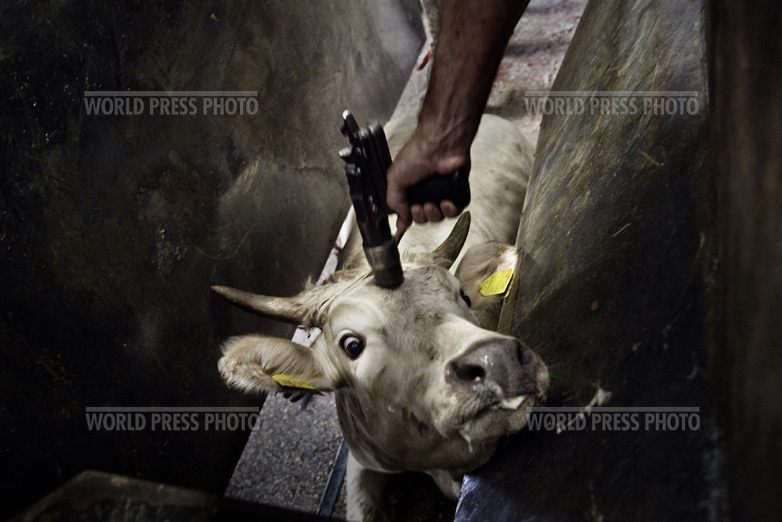
Articles or pictures about meat eating often stimulate big discussions with a lot of responses on the web. Tomasso Ausili is an Italian photographer who won a World Press Photo of the Year Award in 2009, for these pictures (only click if you can stomach it). In the long discussions under the pictures I read in Italian: "we are omnivores and I don't see any reason why we should feel guilty."
Being an omnivore, this argument goes, gives us a license to kill. I think it would, really, if being an omnivore meant that we wouldn't be able to survive without meat. But as it is, being an omnivore just means that in the course of x years of history, we have tended to eat anything, both vegetable and animal products. That's all that it means. Not that we need meat, just that we are used to having it.
But how can being used to have something in itself justify the fact that we continue doing it, when (or if) we feel it's a wrong thing to do?

So often I hear people, also vegetarians, say that we are allowed to kill animals for food, but we should make sure that they get a good life. First of all, hardly any omnivore who thinks like this, acts on it (acting on it would mean eating only meat from not just merely organic but specialised small scale "personal" farming, where the animal is treated better still than in "conventional organic" farming. Secondly, where did we ever get this idea that there's nothing wrong with killing? I have never read a good explanation of why it would be wrong to kill a human, but ok to kill an animal. It's hard to construct an argument for this that makes sense (saying that humans are humans and animals are animals is not an argument, or at least not a morally relevant one). If you want to see what's wrong with killing in just one image, this photo from the previously mentioned photographer says it all, in my view (and I just read in Every Twelve Seconds that the guy doing this job - he's called the "knocker" - needs to visit a psychiatrist every three months. It's in his job description.)

Killing is finishing a life. A life that wants to live. We don't need to eat meat. There is no license to kill.

Sunday, May 13, 2012

Don't tell me what to eat!

People in general don't like to be told what to do. Also concerning the food that's on our plate, we'll decide about that ourselves. We need no government regulations or animal rights or vegetarian groups preaching to us about what to eat, and what not, how much of it, how we should prepare it. We'll make up our own minds about all that, thank you very much.

This free choice, however, is an illusion, and probably nowhere more so than in the domain of food "choices". What most people eat is very heavily determined by agriculture and economy, culture and tradition, what our parents ate, and by what commercial interests want us to eat.

As an illustration of this, check out the graphic from the counting animals website. The chart represents the US advertising budgets of different food cooperations, compared to those of animal interest groups. It would be interesting to compare this also with government budgets for healthy eating.

Friday, May 11, 2012

Dear omnivore

Vegetarians are people too, and people like to understand and want to be understood. Here’s a few lines about how some vegetarians think and feel. (Veg*ns who like the text can feel free to send it their omnivore friends and family with their name under it)

Dear omnivore,

We vegetarians (I should actually just speak for myself) undoubtedly get on your nerves at times. We bother you with our preaching, we are not always willing to eat the things that you serve us, we are quite difficult when visiting restaurants together, we slow down everything when we want to read labels, we may react socially inappropriate at times, and occasionally we even might make you feel guilty. Please know, dear omnivore, that being a vegetarian in a carnivorous world is not always easy, and allow me to give you a small glimpse inside the mind of at least one vegetarian.

When I say a vegetarian life is not always simple, I'm not talking about the thousands of times we have to answer the same questions (what do you actually eat? Where do you get your protein?). Nor am I talking about having to read labels, or about restaurants that do not know what we eat or not eat. No, these kind of things I consider to be the pleasures of being a vegetarian, so to speak.

I am talking about something completely different. It’s something I cannot easily express. It’s about a combination of helplessness and incomprehension. Helplessness in the face of so much animal suffering, and incomprehension and astonishment at the fact that it is not getting addressed and eradicated, or even perceived as such. These feelings, you may say, are not the privilege of vegetarians, and you may be right. But still, it is different in this area than others. For the problem of the endless suffering of animals in the world, there is a solution which is actually quite feasible: it would just mean that all of us start eating only delicious vegetarian food instead of dead animals. When you consider this on a global scale, at the level of all humanity, this solution seems to be (at least in short term) not quite realistic. But at individual level, it surely is possible, in theory, for everyone to join.

And then you, the vegetarian, starts thinking and chewing his thoughts, over and over again. You realize that even if the solution is simple, ultimately it is not happening, and people do not participate, they continue to eat meat. And you wonder why. You wonder if you may be seeing things that are not there. You ask yourself if you are hyper-sensitive or overly sentimental. You consider that you are maybe an alien, or just downright crazy. You tell yourself that it cannot be as bad as it looks, that there must be some justice behind it all. Karma perhaps. But that doesn’t convince you. And again you try to find out what it actually is that you hate so much and whether it is actually so awful as you think. And you keep on coming back to the same conclusion: yes, what happens *is* horrible. Sixty billion animals every year that need to lead a miserably short life, because we humans find their meat tasty. That’s actually all that is going on.

And you wonder why it does not stop and since it is not stopping you ask what you can or should do to make it stop. You try some things here and there, but it is never enough and you can see change but it is very slow. And above all: there seems to be no way to explain the people who don’t see it. You can not even show them any pictures or videos because they do not want to watch them. They tell you all the things you tell them are just exceptions and that in the end it is not all bad. And you’re considered to be adhering to a new religion, or you have simply made another choice than them. And you try to explain that it is *not* just a matter of taste or preference. That eating meat or not eating meat is not a matter of painting the living room in yellow or in green. Because by now you are convinced that not eating animals is not only a compassionate but also a very rational thing to do. How can it be so difficult, you think, to see that we should avoid inflicting pain and suffering and killing where we can easily avoid it? But they don’t understand, and so you try every possible way to explain. You appeal to moral philosophy, to arguments about the environment and health, you cook, you let people taste, and you hope that you have some effect, drop by drop.

And you can see that in almost everyone’s case, all that is needed to understand and feel, is already there. You can see that most people love their cat or their dog, you see that they really can not cope with animal cruelty. Similarly they are not convinced anymore that eating animals is required to be healthy. And yet all the time they tell you that what you are saying is not exactly right, or it is inconsistent, or not feasible, or naive, or not important compared to all the human suffering in the world.

And through all this thinking and talking and discussing, you constantly need to be careful not to seem arrogant. The deadly sin here is to appear as one who thinks he is better than the rest, a moralist who tells other people what to do. You must pay attention that you do not condemn others for what they eat - something which is very difficult because the other very often already feels condemned by your mere presence as a vegetarian. And you must be careful that you do not look like someone who hates because actually you do not hate (although at times you may become a bit more aggressive, intolerant or judgemental, like every human being). You just can not understand, even tough you try so hard.
And of course you must look healthy all the time and can never be sick, because that would be the fault of your diet.

Fortunately, dear omnivore, it is not all doom and gloom in our heads, and there are a few things that make it a little easier. Unlike what you may think, we do enjoy life and the food we eat - many of us discovered the joys of cooking and eating only after having said goodbye to meat and fish. And we definitely can see changes around us, faster and faster. And in our neighborhood and all over the world there are people who feel the same and fight the same fight. If we are crazy, surely we are not alone. We strive together for Something Completely Different.

Personally, what helps me the most is the realization, over and over again, that I myself was eating animals for a long time past the point that I realized I shouldn’t do it. In a way, I am grateful for that. And I am grateful for the fact that I can feel, no matter how inconvenient that may be at times, and that I am vulnerable.

This, dear omnivore, is - very simplified - what is happening daily in my mind. Perhaps in being clear to each other about our feelings, we can find things that unite us and stop talking in terms of me versus you, and may learn to understand each other better.

And to understand is to love, hey tsay.

Thank you for reading

Tobias

PS: not all vegetarians are vegetarian because of animal suffering/animal rights reasons.